Have You Seen Our Clock Buying Guide?
We have developed a master guide to purchasing a custom Grandfather clock. Fill out the form to get access to our guide. (no email required)
Setting the time on your grandfather clock is simpler than you think! Follow our step-by-step guide for accurate timekeeping.
Whether your grandfather clock has lost its sense of time or you’ve just acquired a new one, setting it to the correct time might seem daunting.
But don’t worry – it’s a surprisingly simple process! A few easy steps are all it takes to get it ticking accurately.
So, in this guide, I will walk you through how to set time on a grandfather clock, covering everything from winding the weights to adjusting the pendulum. Soon, you’ll be able to set your clock and enjoy its rhythmic tick-tock confidently.
Let’s get into it, shall we?
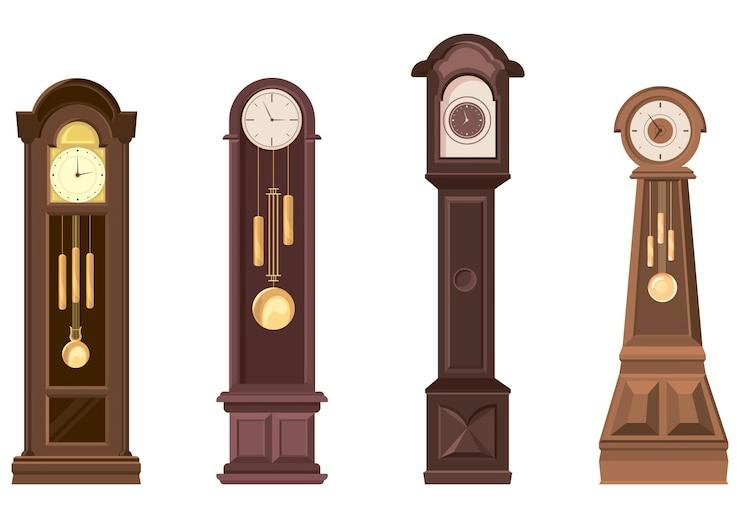
The rhythmic tick-tock of a grandfather clock is powered by an intricate system of weights, gears, and a swinging pendulum. Let’s break down a few essential parts you’ll encounter when setting your clock:
Most grandfather clocks have three weights that hang on chains or cables. Each weight has a specific purpose: one powers the clock’s timekeeping, another powers the strike, and a third the chime. These weights gradually descend and must be wound (typically once a week) to keep the clock running.
When setting the time on your grandfather clock, always move the longer minute hand clockwise or counterclockwise. Check with your owners manual to find out which way to turn the hands. Never turn the shorter hour hand, as this can disrupt the calibration between the time shown on the dial and the strike.
The pendulum, the rod with a weight (the bob) at the bottom, swings back and forth to regulate the clock’s speed. If your clock runs too fast or slow, you’ll usually make adjustments by turning a small nut on the pendulum bob.
This decorative disk, often near the top of the clock face, displays the moon’s current phase. To set it, first determine the date of the next full moon. Then, gently turn the moon dial until the full moon symbol aligns with the current date. The dial will automatically advance as the days pass, mimicking the moon’s cycle.
Some grandfather clocks, particularly those by Howard Miller, feature a unique heirloom capsule. This small compartment, often inside the clock, holds a document recording the clock’s purchase date, reason for purchase, and other significant family information. As the clock is passed down through generations, each new owner adds to the document, creating a treasured record of the clock’s history within the family.
Now that you’re familiar with your clock’s basic workings let’s learn how to set the time on a grandfather clock:
Pro Tip: If your clock refuses to keep accurate time even after winding, adjusting the pendulum, and setting other features, it might indicate a deeper mechanical issue. Consulting a skilled clockmaker is the best course of action in this case.
While setting the time on your grandfather clock is straightforward, a few extra considerations will keep it ticking smoothly for years to come:
Leveling Matters: A grandfather clock must be level for its pendulum to swing correctly. If the clock case tilts even slightly, it can delay the timekeeping. Use a bubble level on top of the clock’s case to check, and carefully adjust the clock’s feet or add shims if needed.
Gentle Touch: Clocks are delicate instruments. Avoid forceful movements when winding the weights or adjusting the pendulum bob. Slow, steady, and gentle handling will protect the delicate gears within.
Environment Matters: Place your grandfather clock in a stable location away from direct sunlight, extreme temperatures, and excessive humidity to safeguard its delicate mechanism.
Watch Out for Wear: If winding becomes increasingly difficult, you notice worn gears or cables, or the clock loses accuracy despite proper maintenance, consult a clockmaker for a potential repair.
Regular Maintenance: Like any fine-tuned machine, grandfather clocks benefit from occasional professional maintenance. Having a skilled clockmaker clean, lubricate, and inspect your clock every few years ensures it performs reliably and reduces the risk of potential problems. They can also offer helpful advice tailored to your specific clock.
Understanding how to set time on grandfather clock should now empower you to maintain its steady rhythm.
If you dream of a custom-designed grandfather clock that reflects your unique style, Old Time Chimes is here to help.
Our skilled artisans will collaborate with you to craft a clock you’ll cherish for a lifetime. We’ll work closely with you to select the perfect materials, incorporate custom details, and build a statement piece that becomes a treasured part of your home.
Contact Old Time Chimes today to start designing your dream clock.