Have You Seen Our Clock Buying Guide?
We have developed a master guide to purchasing a custom Grandfather clock. Fill out the form to get access to our guide. (no email required)
Since their origin, grandfather clocks have been a cherished piece of décor in our homes. Being among the world’s first accurate timepieces, they have sparked curiosity about their invention and history among enthusiasts.
However, grandfather clocks weren’t born from a single idea or experiment; instead, a series of innovations and cultural influences contributed to their creation.
That said, let’s dig deeper into the origin and history of grandfather clocks, along with the logic behind their distinctive name!
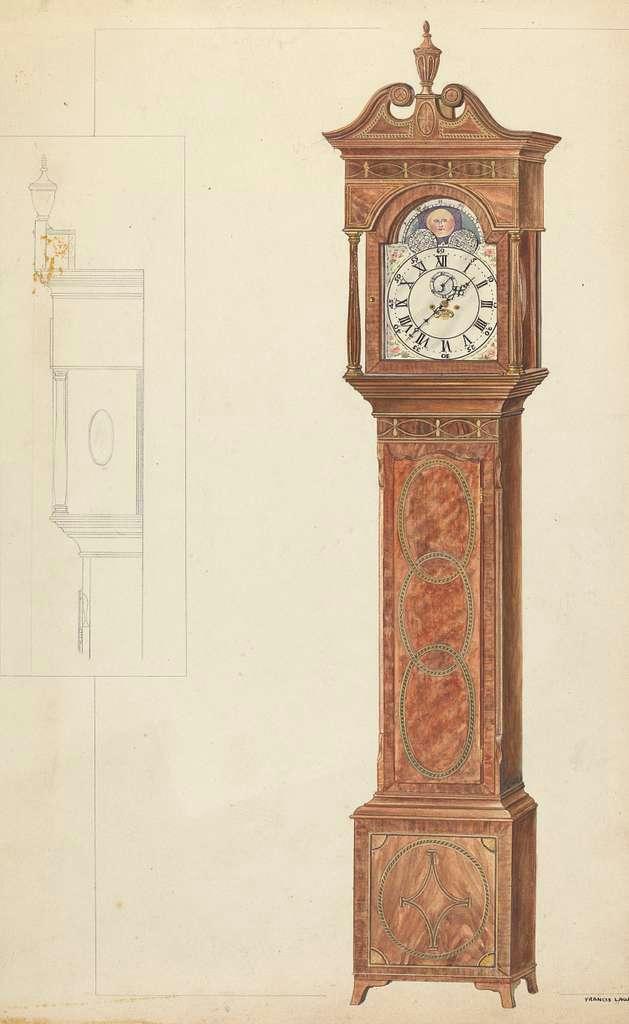
Grandfather clocks, often referred to as longcase or tall-case clocks, bring elegance to any space they adorn. Reaching around 6 to 8 feet in height, these timepieces are often treated as a ‘family heirloom.’
Regarding design, the clock is enclosed in a wooden case, which makes contact with the ground. This case usually features mind-blowing carvings, inlays of various woods, or even painted finishes.
The history of grandfather clocks dates back to the 17th and 18th century. Here’s a quick breakdown of the Golden Age of grandfather clocks.
As a clock enthusiast, you’re surely familiar with Christiaan Huygens – the inventor of the first pendulum clock. Before Huygens came up with a theoretical model of a pendulum, there were various inaccurate mechanical clocks that could easily lose 15 minutes a day. The introduction of a pendulum in a clock brought a remarkable development in timekeeping accuracy, limiting the time error to a mere 15 seconds.
The early pendulum timepiece designed by Huygens was meant to be hung on the wall. This version utilizes a pendulum with a small length, which, in turn, limits its ability to regulate fully accurate timekeeping.
To eliminate the accuracy errors, a clock with a longer pendulum was necessary. This requirement led to the development of the longcase, or grandfather, clock design.
During the Golden age, London, Edinburgh, and Dublin became leading cities in clock-making excellence. Clockmakers attempted to perfect the accuracy by testing various mechanisms, such as deadbeat escapement and anchor escapement.
Such a revolution was also accompanied by the introduction of additional features in clocks like seconds hand, date indication, and music. Timepieces produced around this time are considered as highly-prized collectibles for their artistic value, level of craftsmanship, and profound mechanism features.
When it comes to the development of grandfather clocks, William Clement is often considered a pioneer. Born in 1649, he was a leading clockmaker of the late 17th century. Let’s explore his journey from a regular clockmaker to the inventor of grandfather clocks:
Many people tend to believe that ‘grandfather clocks’ are named after their association with grandfathers. However, that’s not true at all.
To understand the logic behind the name of these timepieces, have a look at this story: Henry Clay Work, an American songwriter, went to England and checked into the George Hotel. Just after entering the hotel lobby, Work spotted a large pendulum clock and asked the staff about it.
After inquiring, he got to know that this timepiece was associated with the hotel’s previous owners. It was rumored that the clock had stopped working when its owner passed away.
Inspired by the story, Work wrote a song known as “My Grandfather’s Clock.” The song was a mega-hit, as around 6 million copies were sold. The public immediately abandoned the term ‘longcase or pendulum clocks’ and adopted the new “grandfather clock” term.
To wrap it all up, the grandfather clock has been captivating enthusiasts with its rich historical significance. Their accuracy and impressive stature made them status symbols for centuries.
Today, grandfather clocks continue to be treasured for their beauty, craftsmanship, and enduring connection to history. If you’re looking for this treasured timepiece, Old Times Chimes is your go-to destination! We offer a distinctive collection of masterpiece grandfather clocks that blend timeless elegance with brilliant craftsmanship. So, visit Old Times Chimes now to explore our handpicked selection!
Grandfather clocks are valued for their detailed craftsmanship, historical significance, and aesthetic appeal. They combine mechanical precision with artistic design, often becoming high-value family heirlooms.
The first grandfather clocks were made in the late 17th century in England. The development of the longcase clock, as it was originally known, was enabled by the invention of the anchor escapement mechanism.
Famous grandfather clock manufacturers include Howard Miller, one of the largest clock makers in the world. Other notable manufacturers are Hermle and Ridgeway.