Have You Seen Our Clock Buying Guide?
We have developed a master guide to purchasing a custom Grandfather clock. Fill out the form to get access to our guide. (no email required)
We’ve all heard of grandfather clocks, but is there a grandmother clock?
For centuries, grandfather clocks have graced homes as a cherished piece of decor. But there’s another timekeeping treasure that deserves just as much recognition: the grandmother clock.
Being a smaller counterpart of grandfather clocks, this timepiece features a rich history and unique style. Eager to bring this iconic treasure to your home? Well, before you do so, it’s essential to understand its unique features, design elements, and historical significance to make an informed decision.
With that in mind, let’s explore all about grandmother clocks in this blog post!
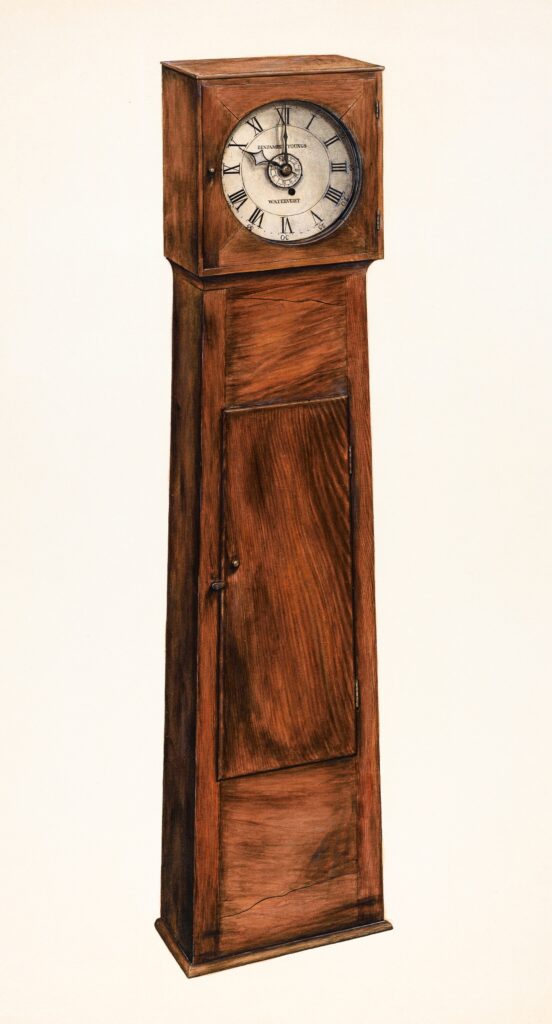
Originating from the broader category of longcase clocks, which emerged in England around the late 17th century, grandmother clocks are distinguished primarily by their size.
While their more renowned counterpart, the grandfather clock, typically stands over 6 feet tall, grandmother clocks are generally shorter, usually ranging between 5 to 6 feet in height.
This difference in size does not denote a compromise in craftsmanship or complexity. Rather, it offers a more versatile option for interior spaces where a full-sized grandfather clock might not fit.
The age of a grandmother clock spans a broad spectrum, reflecting its individual history and provenance. With their origins in the 18th century, the earliest examples of these distinctive longcase clocks are now over 200 years old, marking them as genuine antiques.
Moreover, the production of grandmother clocks saw a significant increase in the 19th and 20th centuries, with a notable surge between 1921 and 1932. This period is particularly interesting for collectors and historians, as it reflects both advancements in clock-making techniques and changes in aesthetic preferences.
The development of grandmother clocks is intertwined with the broader history of tall-case clocks, which emerged in the late 17th century. These clocks were developed to house the newly invented pendulum mechanism, introduced by Christiaan Huygens in 1656, to improve the accuracy of timekeeping.
Today, grandmother clocks are prized for their historical value, craftsmanship, and aesthetic appeal. Modern clockmakers continue to produce grandmother clocks, often incorporating contemporary materials and mechanisms while preserving the classic design elements that define these timeless pieces.
Here’s all about how grandmother clocks function:
Central to the operation of a grandmother clock is the pendulum, whose oscillations regulate the movement of the clock’s hands with exceptional precision. By relying on gravity, this component ensures the timepiece’s accuracy.
The pendulum’s length is directly proportional to its oscillation period; hence, adjustments to it can fine-tune the clock’s timekeeping.
The gears of the clock are interconnected which translates the pendulum’s motion into hand movement. These gears, varying in size, systematically reduce the speed from the clock’s power source, which is usually a weight or spring, to a pace suitable for driving the hands.
Serving as the major part of the clock’s regulatory system, the escapement mechanism permits the gears to advance by a small, precise amount with each swing of the pendulum. This interaction ensures the clock’s hands move forward at a consistent and accurate pace, marking the passage of time with reliability.
Gravity plays another crucial role through the weight, which, upon descending, provides the energy necessary for the clock’s operation. Regular winding of the clock, either by raising the weight or tightening the spring, restores this energy, ensuring continuous motion.
Many grandmother clocks also feature chime mechanisms, striking hourly or playing melodies. These chimes are driven by separate gear trains and hammers that strike tuned bells or rods, adding an auditory dimension to the clock’s function.
The synchronization of chime mechanisms with the main timekeeping elements showcases the clockmaker’s skill in creating a functional piece.
Yes, there is such a thing as a grandmother clock, which is often confused with or compared to the more commonly known grandfather clock. The distinction between the two primarily lies in their size and sometimes in their design details.
Grandmother clocks should be placed on a stable, level surface away from direct sunlight, drafts, and humidity. It’s also advisable to position the clock where its chimes can be enjoyed without causing disturbance.
Yes, like all mechanical clocks, grandmother clocks require regular maintenance to ensure accurate timekeeping and to preserve their condition. This typically includes professional cleaning and oiling of the movement every few years.
Specializing in heirloom-quality clocks, Old Time Chimes offers a remarkable collection of custom timepieces handcrafted by the Amish in the USA. Our commitment to quality is evident in every piece, allowing you to customize your clock to fit perfectly into your space.
By choosing your wood, stain, and other details, you create not just a timekeeper but a piece of art that holds a story and a heritage.
This dedication to craftsmanship makes us a unique destination if you’re looking to enrich your home with pieces that carry forward the legacy of detailed handwork. So contact us now to place your order!