Have You Seen Our Clock Buying Guide?
We have developed a master guide to purchasing a custom Grandfather clock. Fill out the form to get access to our guide. (no email required)
Grandmother clocks, the smaller counterparts of grandfather clocks, are still in fashion because of their versatility, which allows them to fit in smaller spaces. Although slightly different in appearance, the mechanism of both timepieces is almost similar.
For instance, the grandmother clock weights perform the same function as those present in a grandfather clock. But what role do they play? In this blog, we will explore everything you need to know about one of the most crucial components of a grandmother clock, i.e., its weights.
So, let’s get started!
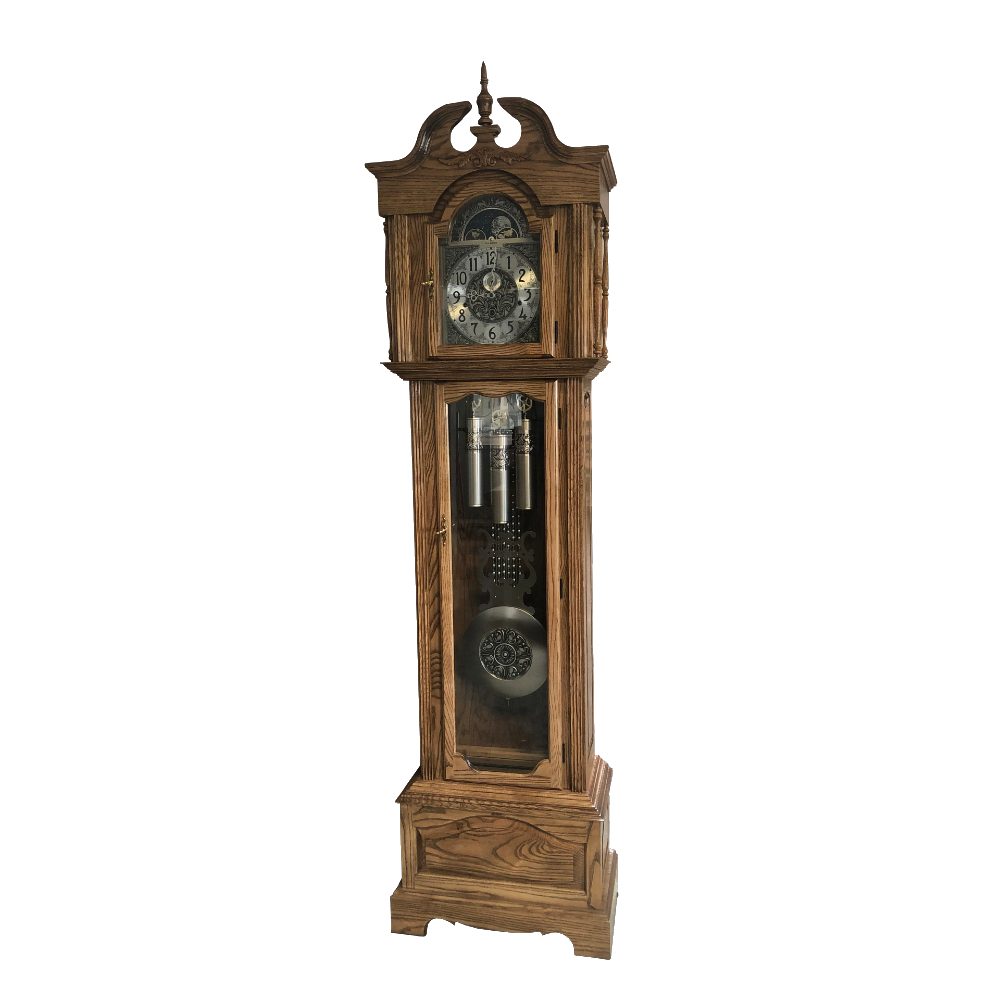
The weights in a grandmother clock play a crucial role in maintaining its movement mechanism. These are heavy objects that function by converting gravitational potential energy into mechanical energy upon descending.
As these power sources go down, they simultaneously drive the movement of the grandmother clock’ gears and maintain the swing of the pendulum. Both these actions are crucial for accurate timekeeping. Moreover, the speed at which grandmother clock weights descend is controlled and regulated for precise measurement of time.
Following is a detailed description of the physical aspects of weights in a grandmother clock:
The weights in this timepiece are cylindrical or shaped like slightly tapered cylinders. Usually, they are made of metal, with brass being a common choice because of their durability, heavyweight, and attractive appearance.
The exterior of the grandmother clock weights can be polished to a high shine or brushed for a more soft finish, depending on the clock’s style.
There is no definite size for the weights as they vary according to that of the clock and the power required by each mechanism. They can typically range in length from 6 to 9 inches (without chains or any attachments), fitting the clock case’s scale and the pendulum’s length.
Similarly, the diameter usually falls under the range of 1.5 to 3 inches. Irrespective of the exact dimensions, the grandmother clock weights may be shorter than those present in a grandfather clock.
The weight of grandmother’s clock weights can vary significantly, usually between 4 pounds to over 10 pounds each. To determine the exact mass, factors like the design of the clock’s mechanism, the energy needed to drive the specific function, etc. play a crucial role. Additional features like complicated dials may require heavier weights.
Some weights are adorned with decorative elements to enhance their appearance. These can include engraved patterns, embossed designs, or decorative caps and bottoms. The level of decoration can vary widely, from simple and subtle to intricate and ornate, reflecting the clock’s overall style and era of manufacture.
Usually, grandmother clocks consist of three weights. However, some may employ two or even one, each having a distinctive function. Let’s explore it all in detail:
As discussed, timekeeping is one of the major functions of weights in grandmother clocks. Let’s explore how they operate it in detail:
Ensuring a Consistent Power Supply: For accurate timekeeping, the grandmother clock must receive a consistent level of power, which is facilitated by weights. By gradually descending, they provide a steady force that does not vary as a spring’s tension might. This consistency ensures the regularity of the pendulum’s oscillations and, thus, the accuracy of the clock.
Besides keeping time, weights also have a role in operating a grandmother clock’s chiming mechanism. Here’s how:
Maintaining Stable Sound Quality: The weights go down in a controlled manner so that the force with which the hammer strikes the bells or rods is consistent. This is crucial for maintaining the chime sound’s quality and volume. Without it, the produced melodies may sound weak or uneven.
Let’s explore some additional mechanisms that are powered by grandmother clock weights:
Winding a clock’s weight refers to the process of raising the weights back to their original position after they have descended under the action of gravity. This is necessary to restore the energy required to power the clock’s movement mechanism.
Typically, the point of connection between the weights and the clock’s mechanism is cables or chains that wind around a drum or pulley. They’re crucial for the adequate transfer of energy from weights to other components of the clock’s movement mechanism.
Many grandmother clocks have glass panels in the front or sides of the case, through which you can sneak peek into how the weights descend. This feature adds to the clock’s dynamic appeal.
Looking for a heirloom-quality grandmother clock for your home or office? Old Time Chimes has got you covered with an exclusive collection of custom-built Amish wood clocks.
From wood type to stain, you get to choose everything by yourself, ensuring the final product aligns perfectly with your space’s decor. You can also go for optional upgrades or add-ons like interior lighting, beveled glass, or wood engraving for just a small fee. Additionally, we also offer a 3-year warranty for your timepiece. So, get in touch with us now to enjoy all these benefits!